
Abbasi was also assertive of Pakistan's nuclear arsenals being safe and secure.

'They are aware that they have been unable to bring about any change in the security situation in Kashmir and have failed to internationalise the Kashmir issue.'
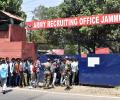
Policy decisions, particularly those which have wide-ranging implications on the nation's health and security, should be decided by bodies best suited to do so, the Delhi high court said on Monday while refusing to interfere with the Agnipath scheme.

His statement comes amidst reports of Chinese soldiers crossing the Line of Actual Control last week after some Tibetans hoisted Tibetan flags on the occasion of Dalai Lama's birthday on July 6.
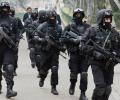
The sources said intelligence-based targeted strikes are being conducted by the Indian Army to neutralise mostly Pakistani and foreign terrorists, and the collateral damage has been very negligible in these operations.

He noted that the primary responsibility of the Indian Army is to maintain operational readiness of the "highest order".
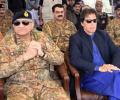
'Any conventional conflict could trigger a nuclear war with results that neither India nor Pakistan could survive easily.' >A revealing excerpt from Shuja Nawaz's The Battle For Pakistan: The Bitter US Friendship And A Tough Neighbourhood.

With frontline IAF fighter aircraft such as the Sukhoi-30, AWACS and UAVs providing live feed of war games to battle field commanders, army is testing its war-fighting doctrine in the Barmer-Jaisalmer sector.
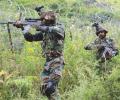
As India progresses towards formulating its own model of theaterisation, the public must get involved in the debate because in the end, it affects the well-being of the entire nation, asserts Biswajit Dasgupta.
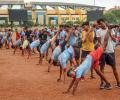
The Supreme Court on Monday dismissed two pleas challenging a Delhi high court judgment that upheld the Centre's Agnipath scheme for recruitment into the armed forces.

Air Chief Marshal VR Chaudhari on Tuesday made it clear that the Indian Air Force is not opposed to the tri-services theaterisation plan but asserted that the doctrinal aspects of the force should not be compromised by the proposed structures.

'A new doctrine now needs to be evolved for a new situation, and the army will do it.' 'You won't see more Kashmiris driven in front of army columns.' 'Nor will the army massacre hundreds, Dyer style,' says Shekhar Gupta.

Easy availability of drones has increased the complexity of security challenges and the Indian military is developing capabilities to effectively deal with the threats, be it from State-sponsored elements or by states themselves, Army Chief Gen M M Naravane said on Thursday.
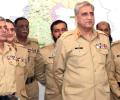
As many as 17 three star generals will retire before General Bajwa hangs his boots, says Rana Banerji, who headed the Pakistan desk at the Research and Analysis Wing, India's external intelligence agency.
Spewing venom against India once again, Pakistan Foreign Minister Shah Mehmood Qureshi has described the Indian Army's 'cold-start doctrine' as an 'irrational' strategy, and said that Islamabad would respond to it 'immediately' and proportionately' if New Delhi acts on that policy.
The fortnight-long meet is a bi-annual one.

After his doctrine of two-front war with Pakistan and China drew flak from across the border, Army Chief General Deepak Kapoor on Friday said India wanted to foster 'cordial and peaceful relations' with both the nations.

The CDS has the option to focus on key areas of capability development to fight new generation wars or get bogged down in trying to bring cosmetic changes to humour the political leadership, asserts Brigadier Narender Kumar (retd).

The army chief said that India needs to broaden its understanding of national security and must examine non-traditional threats like pandemics "de-novo" as they have the potential to inflict severe damage on the country. "We need to act and prepare ourselves accordingly."

While Pakistan enjoys rough parity with India in legacy weapon systems, it is beginning to enjoy superiority in drone warfare, thanks to the RPVs supplied by China, explains Ajai Shukla.

'With two nuclear neighbours, how likely is it for our armed forces to battle in a contaminated environment that could include nuclear, biological or chemical attacks by the adversary?' 'Are we prepared for the threat?' Brigadier S K Chatterji (retd) explains the meaning and significance of Operation Vijay Prahar.
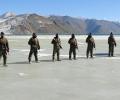
'The Arunachal border is not demarcated in that way, so there can be differing perceptions (between two sides)'

His disqualification to participate in future elections may follow, notes Rana Banerji, who headed the Pakistan desk at RA&W, India's external intelligence agency.

In 2020 India was compelled by China to change its national security strategy. From counter-insurgency, which the army has been focussed on for years, we shifted to conventional war, observes Aakar Patel.

Defence Minister Manohar Parrikar warned the army against "information blackout" as he sought enhanced capabilities to ensure protection from disruptive cyber attacks.
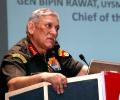
Citing China's example, he said a powerful military will enhance India's strategic clout.
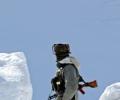
'The necessity of a Mountain Strike Corps is well understood. The problem is in implementing the intention.'

India's historical focus on its continental borders has overshadowed its maritime ambitions, but that is changing quickly, notes Ajai Shukla.

The Indian troops guarding the nearly 3,500-km Line of Actual Control (LAC) maintained an assertive approach in sync with the broader national security doctrine and procured a variety of military platforms and weapons to enhance their combat capabilities.
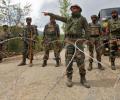
The RSS chief's comment that if war broke out, the military would not be ready for at least six to seven months is correct as it faces a shortfall in training and alertness and an even greater lack of funds for defence preparedness, notes Ajai Shukla.

Maybe, the need for secrecy may have tied the government's hand from sharing details in Parliament. Still, it should consider the need of sharing the utmost within any consultative committee, so that relative secrecy is still maintained. But such a course should involve the prime minister or home minister, as it is much more serious than is being made out to be, argues N Sathiya Moorthy.

A proposed nuclear deal aims to stop Pakistan from building small tactical nuclear weapons that could fall into terrorist hands.

The ministry's year-end review is silent on the continued occupation by Chinese troops of territory that India has always claimed and patrolled.
'Nasr' is a high-precision weapon system with the ability to be deployed quickly, the army said.
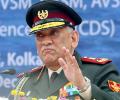
The tearing hurry to form theatre commands has to be replaced by a balanced and deliberate approach. We need to accept that this process will take time if executed correctly and in the best interests of the Indian armed forces, argues Commodore Venugopal Menon (retd).
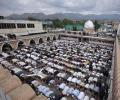
The appointment of General Raheel Sharif as the new army chief of Pakistan has come as a surprise to many. Rajiv Dogra, former ambassador and India's last Consul General to Karachi, speaks to Aabhas Sharma about the appointment, what it says about the priorities of Pakistan Prime Minister Nawaz Sharif and most importantly, what it means for India.

'Pakistan thinks it is winning this low intensity conflict.' 'It is a serious observation. Half the battle is convincing your adversary that he cannot make headway.' 'A lot depends on how the internal professional management of the army and the handling of situations that are bound to rise sooner than later in his command, are done.'
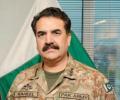
Ending weeks of speculation, Prime Minister Nawaz Sharif on Wednesday appointed Lt Gen Raheel Sharif as Pakistan's new army chief and Lt Gen Rashid Mehmood as the chairman joint chiefs of staff committee.

We would like that people come directly to us rather than resorting to the social media or other means, Gen Rawat said.

A quintessential military commander, Gen Bipin Rawat possessed an uncanny understanding of geopolitical upheavals, calibrated a tri-services military doctrine to make India face myriad security challenges, and is largely credited with bringing down militancy in the Northeast and Jammu and Kashmir.
 © 2026 Rediff.com - Advertise with us - Disclaimer - Privacy Policy - Sitemap - Feedback - About us - Terms of use - Grievances